Roulette, minus the mythology

No betting system beats the wheel.
Some just lose slower.

Martingale, Fibonacci, “99% win rates”, two-dozen coverage, due numbers — taken apart one bankroll at a time, in plain dollars, so you can see exactly what each pattern costs before you ever place it.

Dion Burnside
Dion BurnsideRoulette education — bankroll arithmetic, system breakdowns, and the felt in front of you.
1book, every popular system
383pages of worked arithmetic
$12.99one-time, PDF download
30day full-refund guarantee
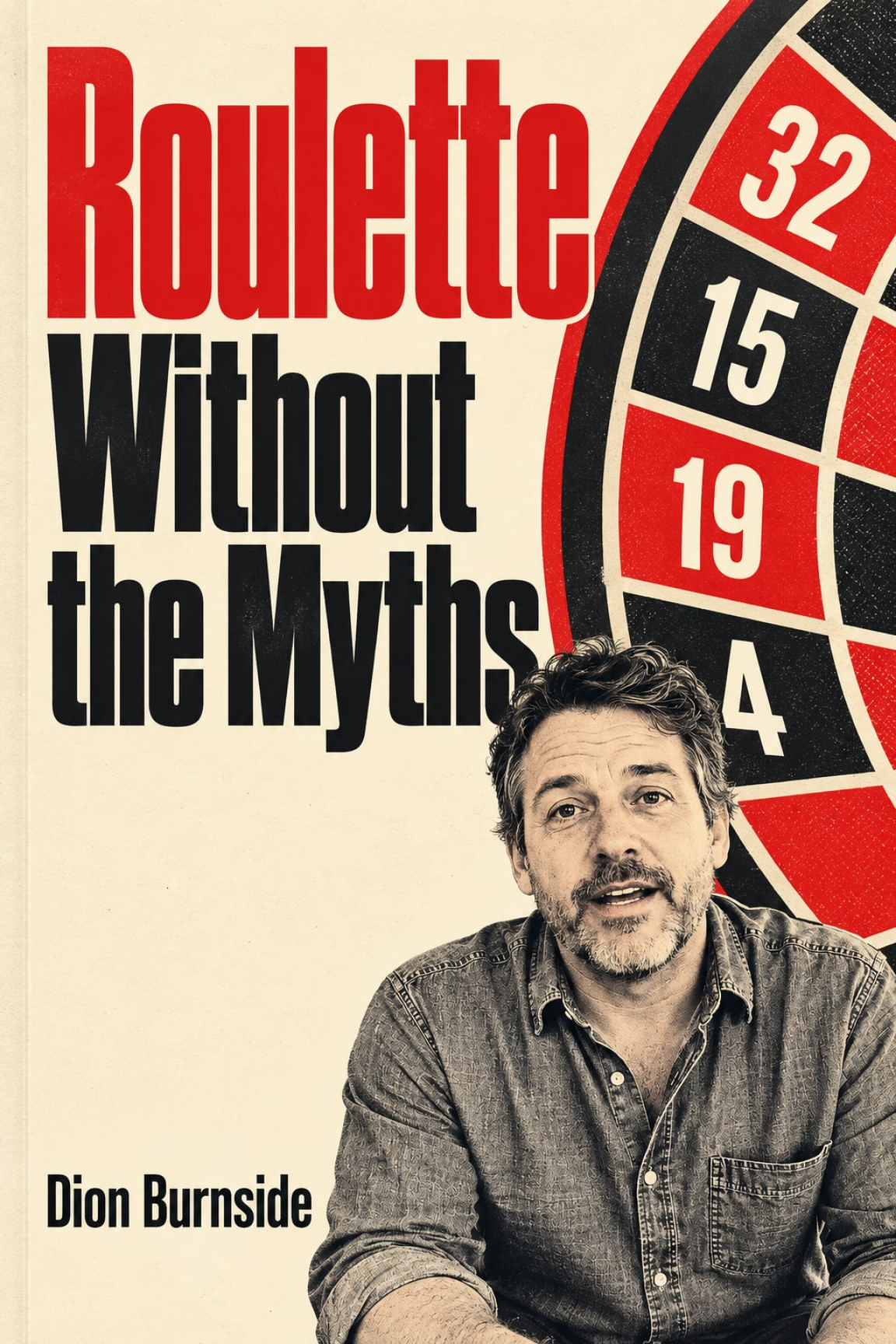
Roulette Without the Myths book cover

Roulette Without the Myths

Every system you’ve been sold, rebuilt on paper first

Each chapter takes one betting idea and runs it through a real bankroll with stated rules — wheel variant, payouts, minimums, limits — so the expensive part shows up before your money does.

  • The $100 session: flat betting vs doubling vs coverage vs one all-in spin — four very different evenings at the same $5 table
  • Martingale to the wall: the four-loss run that strands $75 and demands an $80 bet you can’t make — and its ~6.95% price from a fresh start
  • One failed sequence undoes fifteen winning ones — the asymmetry system sellers never show
  • Fibonacci looks safer than Martingale. Here’s the moment it isn’t.
  • Two dozens, red-and-black, “99% win rates”: why winning more spins can still shrink your balance
  • Numbers are never “due” — what independent spins actually mean at a fair wheel
  • Single, double or triple zero: the wheel choice that quietly costs more per hour than any system saves
  • “$50 a day playing roulette” — the arithmetic behind the claim, honestly totaled
$12.99 Get the book PDF · 383 pages · instant download

The method, in one sequence

Every chapter works this way

  1. State the rules first. Wheel variant, payouts, minimums, bankroll, table limits — the answer changes when any of them does.
  2. Follow the whole bankroll. Not “expected loss per spin” — what your $100 can actually do, including the unlucky path.
  3. Count both sides of the pattern. Win frequency and win size. A system that wins often can still cost more than it returns.
Start (flat $5 on red)$100
Loss 1 · bet $5$95
Loss 2 · bet $10$85
Loss 3 · bet $20$65
Loss 4 · bet $40$25
The system now asks for $80. You have $25. Four ordinary spins — a ~6.95% event from a fresh start — have ended the “recovery” plan with a quarter of your money unspendable. That is the part the demonstration videos skip.
Dion Burnside

Who is Dion Burnside?

An instructor with a calculator, not a system to sell

Dion Burnside teaches roulette the way a careful instructor teaches anything: declare the rules, show the arithmetic, and let the numbers do the talking. The channel and this book share one approach — no “secret patterns”, no lucky-session stories, and no pretending the zero away.

“A betting system doesn’t change what the wheel charges. It changes how you pay it — and some ways cost far more than others.”

Every example in this book declares its wheel variant, payouts, bankroll and limits before concluding anything, because the arithmetic changes when they do. The book’s promise is deliberately modest: understand exactly what you’re paying for the entertainment, and stop paying extra for it.

This book is for you if…

  • You’ve seen Martingale-style advice online and wondered if it really works
  • You want the cost of each wheel and each bet shown in dollars, not hand-waved
  • You play for the evening’s entertainment and want it priced honestly
  • You’d rather know the ~6.95% than discover it mid-session

It is not for you if…

  • You want a system that beats the wheel — not sold here, because it doesn’t exist
  • You’re looking for biased-wheel hunting or advantage play — out of scope
  • You prefer believing numbers are “due”
●

Read it before your next session — 30 days, full refund

Take the book, run the sequences on paper, bring the arithmetic to your next casino night. If it doesn’t change how you stake, reply to your Whop receipt within 30 days for a full refund. No questions, no forms.

Questions

Fair questions, straight answers

Is this book telling me not to play roulette?

No. It prices the game honestly. Roulette can be good entertainment at a known cost — the book’s job is to make sure the cost is the one you chose, not the one a betting pattern hid from you. Flat bets at a single-zero table with a set budget is a very different purchase than doubling into a limit.

Does any betting system work, even a little?

No betting pattern changes the house edge — every chapter shows this in dollars rather than asserting it. What patterns change is volatility: how the losses are packaged. Some packagings (deep progressions) make rare losses catastrophic; the book shows exactly where the wall is for each one.

Which roulette variant does the book use?

Single-zero (European) roulette with standard payouts is the reference game, and double- and triple-zero costs are computed alongside so you can compare wheels in dollars per hour. La partage and en prison are covered where they actually apply.

What do I get, and how?

Instant PDF download, 383 pages, yours to keep on any device. After checkout you land directly on the download page. Questions later? Reply to your Whop receipt.

Know the price before the spin

The wheel will be there either way.

Walk in knowing what doubling costs after four losses, what two dozens really risk, and which wheel charges less for the same evening.

Get Roulette Without the Myths — $12.99

Instant download · 30-day refund · Keep the PDF forever

Roulette Without the Myths
383 pages · instant PDF
Get it — $12.99